

About the author
Dr. Anastacia Munro, MD, is the Medical Director of Parie Med Spa and a fellowship-trained anesthesiologist with more than 10 years of experience in patient care and procedural medicine. She oversees Parie’s clinical standards with a focus on patient safety and evidence-based care.
Professional profiles: Doximity · Healthgrades · Summerlin Hospital directory · NPI Registry
TLDR: Vitamin C and zinc support normal immune function, but these studies do not show an immune benefit from an IV. Before you book, compare the ingredients and check the safety cautions with your provider.
Vitamin C and zinc support normal immune function, but higher vitamin C blood levels after an IV are not proof of better immunity.
With vitamin C IV therapy, you get vitamin C delivered straight into your bloodstream. The plain truth is that a higher blood level is not the same as a better result. Our team reviewed 12 primary sources for this guide, from NIH, FDA and Cleveland Clinic to published studies.
What does vitamin C IV therapy deliver?

An IV delivers its contents into your bloodstream, bypassing your digestive system. Cleveland Clinic describes that route while noting limited scientific evidence for general wellness benefits from IV vitamins in healthy people. Its guidance is an expert overview, not a trial of the two signature formulas below. A vitamin infusion describes what goes in, without telling you what changes afterward.
Your immune system uses both vitamin C and zinc. The NIH vitamin C fact sheet describes vitamin C as important for normal immune function. The NIH zinc fact sheet describes zinc’s immune role too. Those normal roles explain why the ingredients matter, but they do not show an advantage from giving extra amounts through an intravenous drip.
Vitamin C also contributes to processes throughout your body. NIH lists it as necessary for making collagen, L-carnitine and certain neurotransmitters. These are normal biological roles, not measured results from a lounge visit. Seeing collagen on that list is no reason to expect a change in your appearance after an infusion.
Deficiencies in relevant micronutrients weaken immunity, according to NIH’s immune function fact sheet. If you are not deficient, that finding says nothing about an advantage from extra amounts. It describes a shortage, not a reason to keep adding more. Immune support here means a nutrient’s normal role in your body.
Does vitamin C IV therapy reach higher blood levels?
Yes, vitamin C given by IV reached higher peak blood concentrations than vitamin C taken by mouth in a 2004 pharmacokinetic study of 17 healthy volunteers, which measured blood levels without immune or wellness outcomes. For you, the useful finding is about delivery. A comparison of blood levels does not answer whether a drip improves everyday wellbeing.
A blood concentration is not a wellness result. NIH explains that your body tightly controls vitamin C concentrations in blood and tissues. When you read about a higher concentration, look for a measured benefit before drawing a conclusion about your health. A blood-level comparison alone does not tell you what to expect from your lounge visit.
What did oral vitamin C and zinc studies find about colds?

According to the NIH vitamin C fact sheet, taking oral vitamin C regularly does not appear to reduce the risk of the common cold in the general population, although it does appear to modestly reduce how long a cold lasts. If you are comparing a pill with an IV, keep that route attached to the finding. Those oral findings say nothing about ImmuneBoost or ColdBuster.
A 2013 Cochrane review of oral vitamin C at doses of at least 0.2 g a day reported an 8% reduction in adult cold duration with regular supplementation, not IV use. A pooled result is not a forecast for you. Keep the dose and regular oral use in mind when comparing that finding with a vitamin C infusion.
Timing matters when you read vitamin C summaries. The NIH vitamin C fact sheet reports that oral vitamin C started after a cold began did not appear to shorten colds in the general population. Regular use and starting later are different patterns. Neither oral pattern tells you anything about an IV visit.
The oral zinc findings need context too. A 2024 Cochrane review of zinc supplementation, mostly oral lozenges, found low-certainty evidence suggesting shorter ongoing colds alongside more non-serious adverse events. NIH also describes studies of zinc lozenges or syrup taken by mouth early in a cold that found shorter colds without a change in severity, not results for IV zinc. For you, the route and uncertainty matter when weighing a claim about a drip.
| What was studied | What the result means for you |
|---|---|
| Oral vitamin C, regular use | The 2013 Cochrane review of oral vitamin C at doses of at least 0.2 g a day found 8% shorter adult colds with regular supplementation, not IV use. NIH’s fact sheet reports no apparent reduction in cold frequency with regular oral vitamin C in the general population. |
| Oral vitamin C, started later | NIH’s fact sheet reports that oral vitamin C started after a cold began did not appear to shorten colds in the general population. |
| Oral zinc | NIH describes studies of zinc lozenges or syrup taken by mouth early in a cold that found shorter colds without lower severity, not IV findings. The 2024 Cochrane review, mostly oral zinc lozenges, found low-certainty evidence suggesting shorter ongoing colds alongside more non-serious adverse events. |
| IV versus oral vitamin C | The 2004 pharmacokinetic study of 17 healthy volunteers found higher peak blood concentrations with IV versus oral vitamin C, without measuring immune or wellness outcomes. |
What is inside ImmuneBoost and ColdBuster?

Both formulas contain vitamin C, Zinc, B-12, B Complex and Magnesium Chloride. ColdBuster also lists B-6 and Glutathione. You will find the full lists below, making it simple to compare the shared ingredients and the additions.
- ImmuneBoost contains B-12, B Complex, Magnesium Chloride, vitamin C and Zinc.
- ColdBuster contains B-6, B-12, B Complex, Magnesium Chloride, vitamin C, Zinc and Glutathione.
Glutathione is one of the antioxidants found inside your cells, as described in a 2026 review’s account of glutathione biology. That description explains the ingredient, not the effects of a signature formula. ColdBuster has a longer ingredient list. A longer list alone tells you nothing about a greater benefit.
You will find the listed ingredients on the ImmuneBoost ingredient page and ColdBuster formula page. B vitamins appear in both formulas, including B-12 and B Complex. For a closer look at that shared part of the list, read the guide to B12 and B vitamins.
Who should avoid an IV vitamin infusion?
If you are seeing a healthcare provider for heart disease, high blood pressure, kidney disease or pregnancy, Cleveland Clinic advises avoiding IV vitamin therapy. That caution applies even when the ingredients sound familiar. Tell your provider about your health history before choosing a nutrient infusion.
Bruising at the needle site and negative interactions with medicines are among the possible risks Cleveland Clinic lists. Its guidance gives no rates, so it does not tell you how often those events happen. Your medicine list matters alongside the ingredient list. Share every medicine you take before choosing intravenous therapy.
Glutathione’s suitability for injection matters too. The FDA’s August 2026 glutathione alert followed adverse-event reports involving IV products made with supplement-grade material from one supplier. It gives no risk rate for all glutathione drips and says nothing about this lounge’s sourcing. Before choosing a formula with glutathione, ask where your ingredients come from and whether they are suitable for injectable use.
What does The Drip Room offer for your vitamin C IV therapy visit?
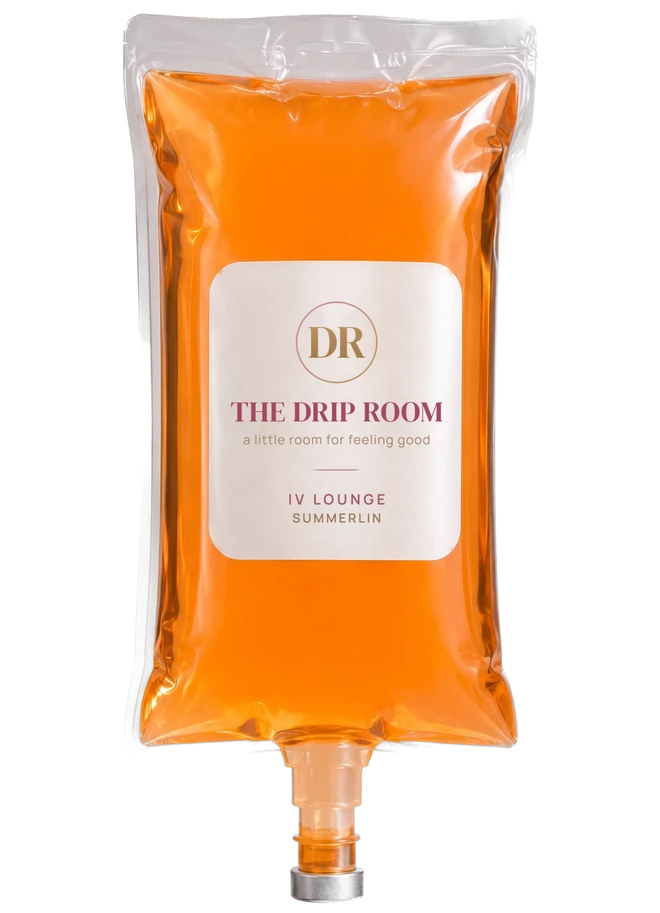
The Drip Room is an IV lounge at 1725 Village Center Cir #110 in Summerlin, Las Vegas, and a sister brand of Parie Med Spa. Its ten signature drips are formulated by medical professionals and delivered by licensed providers. Your options also include NAD+ IVs and booster shots, Monday to Sunday from 9 AM to 7 PM.
For your ingredient comparison, ImmuneBoost lists B-12, B Complex, Magnesium Chloride, vitamin C and Zinc. ColdBuster lists B-6, B-12, B Complex, Magnesium Chloride, vitamin C, Zinc and Glutathione. For your visit details, reach The Drip Room at (725) 248-1113.
Vitamin C IV Therapy FAQ
Can vitamin C IV therapy stop a cold?
No evidence here shows that it does. NIH’s summary of oral vitamin C research covering 29 studies and more than 11,000 people reports no change in cold severity when oral vitamin C was started after symptoms began. If you are hoping to change how a cold feels, that oral finding gives no basis for expecting an IV benefit.
Is vitamin C by IV better than taking vitamin C pills?
Higher blood levels alone do not demonstrate a better wellness result for you. NCBI’s pharmacology definition calls an active drug delivered directly into circulation by IV 100% bioavailable. That number describes delivery, while Cleveland Clinic’s expert guidance, not a trial, notes limited data for general wellness benefits from IV vitamins in healthy people.
What’s the difference between ImmuneBoost and ColdBuster?
ColdBuster adds B-6 and Glutathione to the shared ingredient list. Both contain Magnesium Chloride, and NIH describes magnesium’s normal roles in your energy production, nerve signaling, muscle contraction and heart rhythm. Those roles explain the ingredient without showing that either formula changes how you feel or perform.
Is zinc in an IV the same as a zinc lozenge?
No, the delivery routes differ, and the oral findings do not show what zinc in an IV would do for you. Beyond its immune role, NIH says zinc is required for the activity of hundreds of enzymes in your body. That broad role in your body is not a head-to-head test of a lozenge against an IV.
Who should avoid vitamin C IV therapy?
You should avoid it if you are seeing a healthcare provider for heart disease, high blood pressure, kidney disease or pregnancy, according to Cleveland Clinic. Dose matters too, with NIH warning that extremely high magnesium doses carry a risk of magnesium toxicity. That warning does not state a dose or a risk level for either signature formula.
How often should I get a vitamin C infusion?
No visit interval is supported by the studies here. If you are comparing formats before planning repeat visits, The Drip Room’s booster shots page also lists vitamin C, B12 and B Complex. A shot is a separate route from the oral products studied, and its availability does not supply evidence for a schedule.
Want to compare your vitamin C infusion ingredients? Read about the ImmuneBoost formula at The Drip Room in Summerlin, Las Vegas. New clients pay $99 for any signature drip, one per guest. You will find the details when you see the new client special. Book your drip at The Drip Room.
Like this article? Add The Drip Room as a preferred source, and you are more likely to see our articles in Google’s Top Stories.